
In this exercise, and for the sake of demonstration, we will be looking at a curated set of data taken from MICS Yemen 2013. A quick analysis will be conducted on a set of Health related indicators in Yemen utilizing Tableau Desktop as the software of choice for the visualization.
What is MICS
To give a well rounded explanation of what MICS is, here’s a summary taken from UNICEF’s website summarizing it:
The Multiple Indicator Cluster Survey (MICS) is a household survey programme developed by UNICEF to assist countries in filling data gaps for monitoring human development in general and the situation of children and women in particular. MICS is capable of producing statistically sound, internationally comparable estimates of social indicators.
The current round of MICS is focused on providing a monitoring tool for the Millennium Development Goals (MDGs), the World Fit for Children (WFFC), as well as for other major international commitments, such as the United Nations General Assembly Special Session (UNGASS) on HIV/AIDS and declarations issued by the League of Arab States and related institutions and organizations concerned about child rights in Arab countries, and the Cairo Declaration “Towards an Arab World Fit for Children”, and the Second Arab Work Plan for Children (2004-2015) that was adopted at the Arab Summits.
The data and reports resulting from the survey are made available to the public. To access all the MICS Yemen 2006 resources, click here.
For our purposes here, I will lay out selected data snapshots and then attempt to analyze them.
Setting Up The Data
Mother's Age:
| Background characteristic | Mother’s Age <20 | Mother’s Age 20-34 | Mother’s Age 35+ |
| Percentage with antenatal care from a skilled provider | 62 | 61.4 | 51.4 |
| Percentage whose last live birth was protected against neonatal tetanus | 23.9 | 29.5 | 24 |
| Number of ever-married women | 1192 | 7398 | 1779 |
| Percentage delivered by a skilled provider | 50.9 | 44.9 | 37.5 |
| Percentage delivered in a health facility | 33.1 | 29.9 | 26 |
| Percentage delivered by C-section | 3.8 | 4.9 | 5.4 |
| Number of births | 2109 | 11521 | 2250 |
Residence: Urban vs Rural
| Background characteristic | Residence Urban | Residence Rural |
| Percentage with antenatal care from a skilled provider | 79.9 | 51.3 |
| Percentage whose last live birth was protected against neonatal tetanus | 37.5 | 23.8 |
| Number of ever-married women | 3,077 | 7,292 |
| Percentage delivered by a skilled provider | 73 | 34.1 |
| Percentage delivered in a health facility | 49.1 | 22.6 |
| Percentage delivered by C-section | 10.2 | 2.8 |
| Number of births | 4,301 | 11,579 |
Mother's Education:
| Background characteristic | No education | Fundamental | Secondary | Higher |
| Percentage with antenatal care from a skilled provider | 47.9 | 68.7 | 79.8 | 93 |
| Percentage whose last live birth was protected against neonatal tetanus | 21.3 | 30.3 | 44.1 | 55.9 |
| Number of ever-married women | 5,475 | 3,463 | 1,025 | 407 |
| Percentage delivered by a skilled provider | 31 | 56.3 | 69.8 | 88.8 |
| Percentage delivered in a health facility | 21.2 | 36.6 | 44.9 | 64.5 |
| Percentage delivered by C-section | 2.6 | 6.2 | 7.7 | 19.8 |
| Number of births | 8,765 | 5,123 | 1,446 | 546 |
Indicators By Governorate:
| Governorate | Gov Code | Percentage with antenatal care from a skilled provider | Percentage whose last live birth was protected against neonatal tetanus | Number of ever-married women | Percentage delivered by a skilled provider | Percentage delivered in a health facility | Percentage delivered by C-section | Number of births |
| Al-Mhrah | YE28 | 79.8 | 35 | 42 | 64.7 | 59.9 | 7.7 | 63 |
| Mareb | YE26 | 66.4 | 29.8 | 78 | 45.2 | 38.5 | 3.8 | 120 |
| Al-Jawf | YE16 | 57.3 | 10.5 | 95 | 53.8 | 38.1 | 4.3 | 144 |
| Shabwah | YE21 | 67.3 | 8.7 | 194 | 53 | 39.5 | 5 | 275 |
| Abyan | YE12 | 70.5 | 19.3 | 207 | 74 | 57.5 | 6.1 | 309 |
| Aldhalae | YE30 | 68.4 | 28.4 | 251 | 44.9 | 30.1 | 2.7 | 384 |
| Aden | YE24 | 88.2 | 52.9 | 291 | 83.7 | 67.4 | 12 | 389 |
| lahj | YE25 | 67 | 31.3 | 276 | 51.8 | 41 | 5.4 | 416 |
| Reimah | YE31 | 18.2 | 14.3 | 246 | 12.6 | 3.7 | 0.7 | 423 |
| Sadah | YE22 | 31.1 | 5.4 | 320 | 30.3 | 28.8 | 1.2 | 479 |
| Al-Mhweit | YE27 | 36.2 | 31.2 | 304 | 34.2 | 17.5 | 3.5 | 517 |
| Al-Baidha | YE14 | 59.7 | 15.6 | 446 | 61.2 | 43.6 | 7.9 | 643 |
| Amran | YE29 | 53.4 | 32.8 | 445 | 35.3 | 23.7 | 2.3 | 670 |
| Hadramout | YE19 | 80.8 | 36.5 | 543 | 65.3 | 53.3 | 7.4 | 738 |
| Sanaa | YE23 | 52.8 | 16.7 | 598 | 35.8 | 28.8 | 6.2 | 919 |
| Hajjah | YE17 | 38.6 | 31.6 | 620 | 20.1 | 12.8 | 1.4 | 1,019 |
| Sanaa City | YE13 | 84 | 33.8 | 933 | 74.8 | 56.5 | 13.4 | 1,280 |
| Dhamar | YE20 | 34.7 | 31.9 | 802 | 22.1 | 16 | 1.6 | 1,322 |
| Ibb | YE11 | 75.7 | 27.9 | 1,147 | 42.4 | 30.7 | 6.1 | 1,738 |
| Taiz | YE15 | 60.9 | 31.9 | 1,274 | 41.5 | 22 | 3.2 | 1,994 |
| Al-Hodiedah | YE18 | 56.5 | 25.6 | 1,257 | 48.9 | 18.5 | 2.8 | 2,037 |
Analysis
Indicators On The Broader Level:
Notes
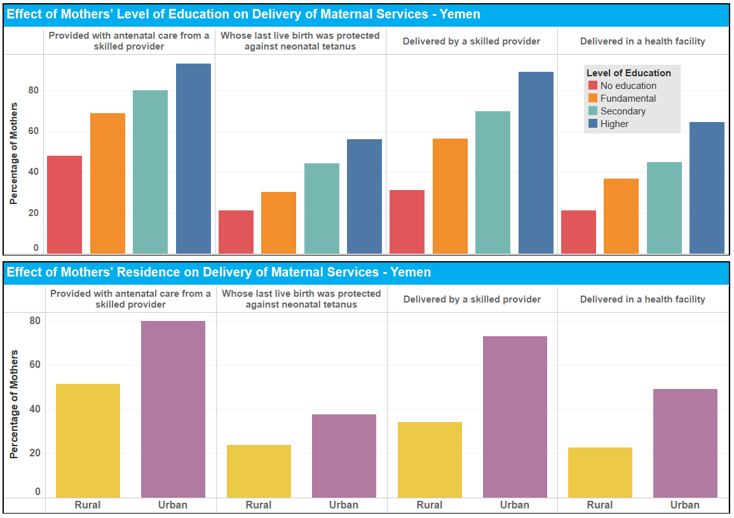
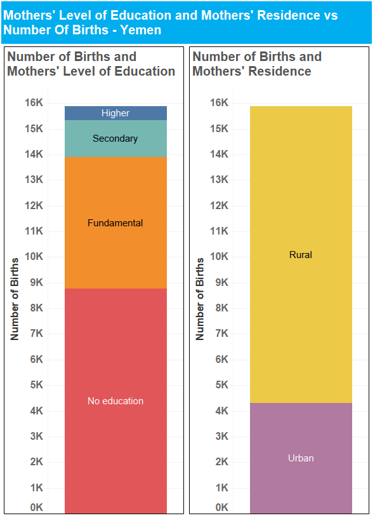
- There’s a higher number of uneducated mothers who also have a high number of births and much fewer maternal services (antenatal care, neonatal tetanus protection and so on)
- The vast majority of mothers live in rural areas and they, too, receive fewer maternal services on every one of the four categories
- There’s a notable trend on each one of the services relative to the mothers’ level of education and type of residence.
On the Governorate Level:
Notes
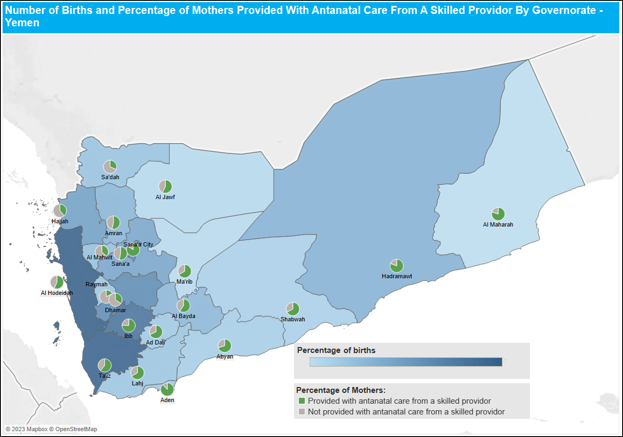
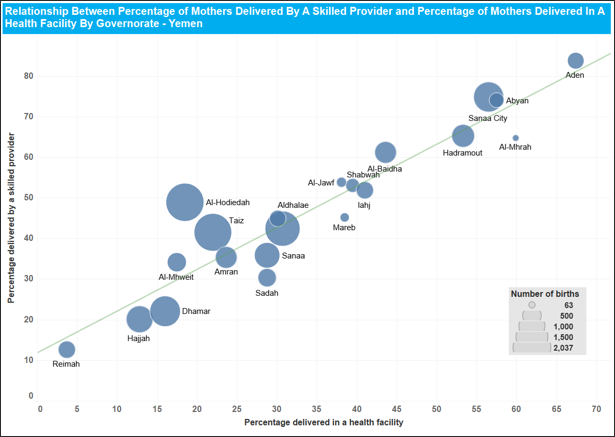
- Number of births is the baseline on which we should focus our efforts, you can see it’s more pronounced in Al-Hodiedah, Taiz, Sana’a, Dhamar, Sana’a City
- Governorates like Al-Hodiedah, Taiz and Dhamar have high numbers of births but the percentage of mothers provided with antenatal care from a skilled provider is relatively low. The same goes for other services as well.
- On the scatter chart, we see Al-Hodiedah governorate that has a large number of births, and has a larger percentage of delivered by as skilled provider as compared to other governorates, that could indicate the lack of nearby health facilities to provide skilled care.
- We can see how low Raimah, Sadah, Hajah and Dhamar are in their antenatal, delivery in health facilities, and delivery by skilled providors.
Final Recommendations
- It’s abundantly clear that there is a general lack of maternal services delivered for all categories of mothers in Yemen.
- It’s essential to strengthen the referral system and network all the way from the health units to health centers, to district hospitals all the way to referral hospitals, so rural areas can get more coverage.
- We should also consider reinforcing the integrated outreach services to get antenatal care and prevention against neonatal tetanus to every household regardless of their level of education.
- Another course of action is to carry out awareness campaigns that emphasise to women in the child bearing age the importance of seeking maternal services, proper education, family planning and the dangers of early marriage.
- Health units and health centers should be supported with basic needs to function as a Basic Emergency Obstetric and Newborn Care (BEmONC). Furthermore, district and referral hospitals must be able to provide Comprehensive Emergency Obstetric and Newborn Care (CEmONC) that is at least capable of performing c-section when necessary.
- Another crucial step is to train community midwives that come from the same vicinity as the health facility, and continue to actively coach them.
- In Raimah, where there’s a significant lack of maternal services due to their rough roads and hard to reach areas, it’s important to focus on them by dispatching mobile teams.